
$600 Billion Later: A 1-year autopsy of the day DeepSeek "broke" Nvidia.
A Wider Zoom: How the AI Story Was Supposed to Go
For much of the 2020s, the emerging AI sector was shaped — technologically, economically, and narratively — by a small group of predominantly North American companies.
They trained the largest models.
They controlled the largest compute clusters.
They attracted the largest volumes of capital ever deployed in a single technological domain.
From the outside, this dominance appeared natural. Frontier AI seemed to follow a familiar logic: intelligence scales with resources. The more data, compute, and capital you could marshal, the more capable your models would become. By 2024, this logic had hardened into an industry consensus. Not a written doctrine, but an operating assumption shared across labs, investors, policymakers, and supply chains.
The Implicit Consensus
Several beliefs quietly structured how progress in AI was understood:
- Frontier capability requires frontier-scale capital
- Scaling laws reward brute force more reliably than ingenuity
- Control over advanced hardware defines competitive boundaries
- Efficiency matters — but only after scale is secured
These assumptions reinforced each other. Capital justified scale. Scale justified hardware dependence. Hardware dependence justified export controls. Export controls reinforced confidence in incumbents.
This worldview went largely unchallenged — not because alternatives were impossible, but because they seemed unnecessary. Until January 2025.
The Break in the Pattern
On January 27, 2025, just 365 days ago, DeepSeek released DeepSeek-R1, a reasoning model broadly comparable to Western state-of-the-art systems. The model itself was impressive. What followed was unsettling. DeepSeek disclosed that the underlying base model (V3) had been trained for approximately $5.6 million — a fraction of the cost widely assumed to be necessary for frontier performance.
The industry reaction was not disbelief at the result. It was discomfort with the implication that a stack of assumptions collapsed.
Assumption Stack #1: Frontier AI Requires Frontier Capital
What We Were Told
State-of-the-art models demand state-of-the-art budgets. Hundreds of millions — soon billions — were framed as the unavoidable entry fee. Capital intensity became synonymous with seriousness.
What Happened Instead
DeepSeek achieved frontier-level reasoning without hyperscaler backing, without unrestricted access to the latest chips, and without the balance sheet of a Big Tech incumbent.
The barrier to entry turned out not to be capital itself — but how capital was being spent. Nothing new in the innovation space, where the saying goes, that resources can never compete with resourcefulness.
If frontier capability can be achieved at a small fraction of the expected cost, what exactly was the money buying before?
Assumption Stack #2: Scaling Laws Are Linear and Inevitable
What We Were Told
To get a meaningfully better model, you need exponentially more compute.
This belief justified ever-larger clusters and underwrote the hardware growth narrative of the entire sector.
What Happened Instead
DeepSeek leaned heavily on architectural efficiency: Mixture-of-Experts routing, low-precision (FP8) training, and aggressive optimization of the software stack.
The result wasn’t a rejection of scaling laws — but a reframing of them.
Performance gains were no longer tied exclusively to raw compute growth. They could also come from rethinking how compute was used. An uncomfortable truth. Were we hitting the ceiling of model performance — or just the ceiling of convenient engineering?
Assumption Stack #3: Hardware Control Equals Capability Control
What We Were Told
If you control access to the most advanced chips, you control the pace of AI progress. Export restrictions on cutting-edge GPUs were assumed to be a durable strategic moat.
What Happened Instead
DeepSeek trained its models on export-restricted H800 GPUs, not the latest H100s or Blackwell-class chips.
Constraint did not stall progress.
It forced different trade-offs — and, in some cases, better ones.
For Western observers, this was deeply uncomfortable. The implication was not that sanctions failed outright, but that hardware scarcity does not necessarily translate into innovation scarcity. Reader Pause
What happens to geopolitical strategy if constraint accelerates ingenuity instead of suppressing it?
Assumption Stack #4: Efficiency Is a Second-Order Concern
What We Were Told
First build the biggest possible model. Efficiency can come later — if and when it becomes necessary. This assumption was rarely stated explicitly, but it shaped incentives, roadmaps, and internal prestige across the industry.
What Happened Instead
DeepSeek treated efficiency not as optimization, but as existential strategy. Where Western labs absorbed inefficiency as the cost of speed and abundance, DeepSeek treated inefficiency as unacceptable risk. The difference wasn’t intelligence or talent — it was pressure.
Abundance tolerates waste. Constraint does not.
The Market Reaction: A Psychological Inflection Point
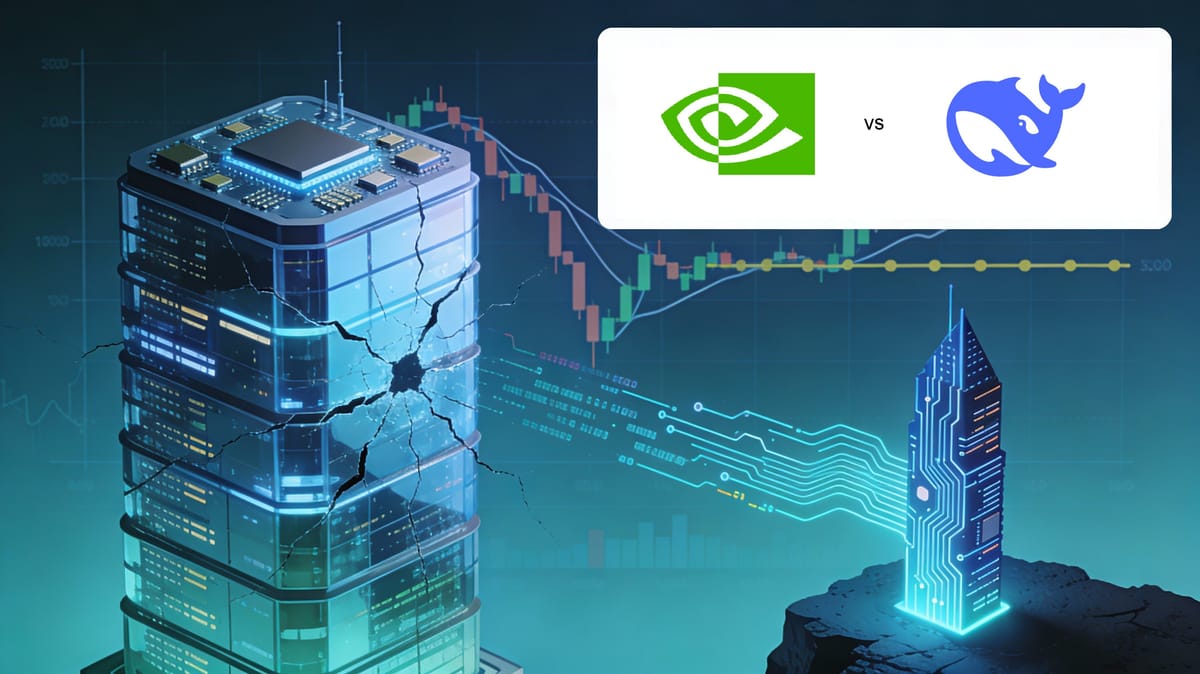
The immediate financial fallout was dramatic. Nvidia lost roughly $600 billion in market value in a single day, the largest one-day wipeout in history. But the deeper shift was psychological. Investors stopped asking, “How big can this get?” They started asking, “How efficiently can this be done?”
The consequence wasn't that the AI bubble did not pop. The blank-check era did.
Seen from 2026: What Actually Changed
Looking back, the DeepSeek Moment did not reduce demand for compute. If anything, it expanded it — cheaper AI made more applications viable.
What changed was the character of progress:
- Efficiency moved from footnote to first principle
- “God models” lost their mystique
- Smaller, task-specific, agentic systems gained legitimacy
- Software excellence reasserted itself over hardware determinism
Most importantly, inevitability died.
Why These Assumptions Persisted
These beliefs survived not because they were rigorously tested, but because they were convenient: 1) Investors needed narratives that scaled with capex, 2) Governments preferred hardware chokepoints to software uncertainty, and 3) Large labs mistook past success for structural necessity
The assumptions reinforced each other — until reality broke the loop.
Open Questions
- How many current “hard limits” in AI are simply unexamined habits?
- Does constraint reliably produce better systems — or just different blind spots?
- If efficiency compounds faster than compute, who actually owns the long-term advantage?
Next Autopsy: Sanctions as Innovation Accelerants
Previous Autopsy: The Innovation Doesn't Survive Politics. The System Breaks Them Both.
Destruction Desk is an independent editorial publication performing weekly autopsies on failed assumptions in innovation, transformation, and the Valley of Death between lab and market.