
Share

Oman Didn't Break the Rules. It Revealed They Were Already Bent.

Oman Didn't Break the Rules. It Revealed They Were Already Bent.
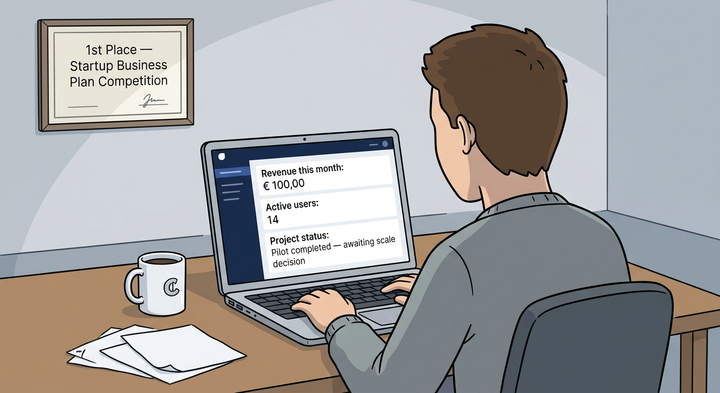
When suddenly your assumptions are beginning to crack. (AI generated Image, Gemini

The Assumption

Founders plan across borders on a premise they rarely state out loud: that rule of law and arm's-length enforcement bind reliably — that treaties, alliances, and single-market law hold even for the most powerful actors, and even when honoring them is inconvenient. But this predictability is the backbone that lets you raise capital in one jurisdiction, manufacture in a second, and sell into a third. This autopsy tests whether that backbone still holds.

The Time Horizon Mismatch

The assumption was calibrated for a specific world. NATO, the WTO, the TFEU's single-market guarantees — all built between 1945 and the 1990s, designed for slow, consensus-based change, where breaking a commitment carried decades of reputational cost and no immediate alternative partner was waiting.

It is now operating inside a different world. Commitments are renegotiated unilaterally. Enforcement is tit-for-tat. The cost of breaking a rule is priced against this week's leverage, not this generation's credibility. Oman is this week's instance: a treaty-adjacent partner threatened with force over a shipping dispute isn't a rupture of the system. It's the system's new operating speed, made visible. The rulebook did not disappear. It is still on the shelf, still cited, still invoked in press statements. What changed is the time horizon of the actors reading it — and a rulebook written for patient institutions does not constrain impatient ones.

The Reality Check

Two dated, sourced cases, on two different continents, inside two entirely different legal systems, show the identical mechanism: a rule exists specifically to bind an "insider" — an ally, a fellow member state — and gets bent anyway once a domestic interest is strong enough, with an outside authority left to intervene after the fact.

ActorRequired behaviorActual behaviorDate / Source
United States (Trump admin.)Honor alliance commitments even when a negotiation stallsThreatens military action against Oman, a treaty-adjacent ally, over the Strait of Hormuz disputeAug 17–18, 2026 — NBC, CBS, Washington Post
Italy (Meloni government)Use "golden power" national-security review only for genuine security grounds, per EU lawUses it to impose crippling conditions on a purely domestic bank merger (UniCredit–Banco BPM); bid withdrawnApr–Jul 2025 decree/withdrawal; EU infringement opened Nov 21, 2025 — European Commission, Reuters, Bloomberg

The same failure mode — rule exists, applies to "us," gets stretched under pressure, someone else has to correct it after the fact — recurred within twelve months, in a military alliance and in single-market banking law. Two cases carry this argument further than ten would: the recurrence across unrelated systems is the evidence, not the volume of anecdotes.

The Consequence Cascade

First-order effect: a specific deal or negotiation is blocked or threatened.

Second-order effect: every other actor watching — competing bidders, other treaty partners, other founders with cross-border plans — revises the probability that a similar commitment will hold for them.

Third-order effect: capital and hiring decisions that depend on that probability get deferred, not cancelled. Deferral is quieter than a headline and harder to trace back to its cause, which is precisely why it is underpriced. A founder who delays a European manufacturing decision by two quarters because the arm's-length principle looks shakier this year will rarely cite Oman or Banco BPM as the reason — but the caution has the same root.

Fourth-order effect: the erosion isn't only structural. OECD's 2025 Trust Survey (33 countries, fielded autumn 2025) found trust in national government roughly split — 43% low or no trust versus 40% high or moderately high — and stabilizing or improving in about half the countries where it had previously fallen; this is not a clean decline story. But Edelman's 2025 Trust Barometer found something sharper: 4 in 10 respondents with high institutional grievance say they would approve of hostile activism — disinformation, harassment, property damage, or violence — to force change. When institutions visibly bend their own rules, some citizens conclude the rules were never binding on anyone, including themselves.

Contrarian framing: the rule didn't fail loudly enough to be blamed. It rather failed quietly enough to be absorbed into everyone's risk premium instead.

The Counterfactual Scenario Builder

UniCredit's parallel pursuit of Commerzbank belongs here, not in the evidence table above — and the distinction matters. Germany has resisted the deal as a shareholder (the state holds roughly 12.7% of Commerzbank) and on commercial grounds ("insufficient premium"), not by inventing a legal security review the way Italy did. That is an ordinary property right, available to any shareholder. It is not, on the documented record, the same category of state power as golden power.

Scenario: if Germany had not happened to hold a blocking stake, would Berlin have found another lever — a BaFin delay, a golden-power-style statute of its own, political pressure timed to a regulatory decision? We don't know. That we cannot rule it out is itself the point. When resisting a cross-border merger is this easy to justify after the fact, through whichever tool happens to be within reach, the formal rule was never the binding constraint. The sovereign's willingness was — and willingness doesn't show up in any treaty text.

Open Questions

  • Recessions get an official start date, months after the fact. Is there an equivalent for institutional breakdown — or do founders, owners, and industry leaders only ever recognize "chaos" in hindsight, once it's too late to have priced it?
  • Who benefits from founders, owners, and industry leaders continuing to assume the old rulebook holds — and who benefits from them assuming it's already dead?
  • The WTO's own enforcement mechanism, the Appellate Body, has been unable to hear appeals since December 2019 — six years of a dead "supreme court" for global trade, largely unremarked outside trade-policy circles. If the most important rulebook of the postwar era lost its teeth this quietly, what does that say about how much resistance actually meets a rulebook dying?
  • Why does the same pressure produce a legal workaround in Rome and a shareholder maneuver in Berlin — does the mechanism matter less than the outcome, for a founder deciding where to build?
  • Are founders, owners, and industry leaders only victims of a bending rulebook — or are some of the same people betting on bending it themselves, chasing monopoly, regulatory arbitrage, or first-mover advantage precisely because enforcement is inconsistent?
  • If we designed for an independent, fast, cross-border enforcement mechanism from scratch today, what would it need that the current one visibly lacks?
  • What would finally make this assumption either reliably true again, or permanently false, in the next five years — and would either outcome actually change how you plan?

A Note on Method

This piece uses two documented cases and one clearly labeled counterfactual — deliberately, rather than a longer list of anecdotes. A third case (Commerzbank) was considered and kept, but moved outside the evidence table once it became clear it rests on a different mechanism (shareholder leverage) than the other two (legal reinterpretation).


Destruction Desk
We perform autopsies on innovation’s failed assumptions.


This newsletter was edited by Manfred Lueth.


You received this email because you signed up for this newsletter from DestructionDesk.com.
To stop receiving this newsletter, unsubscribe or manage your email preferences

Subscribe to Destruction Desk

Sign up now to get access to the library of members-only issues.
jamie@example.com
Subscribe