
The Anatomy of a Slow Collapse
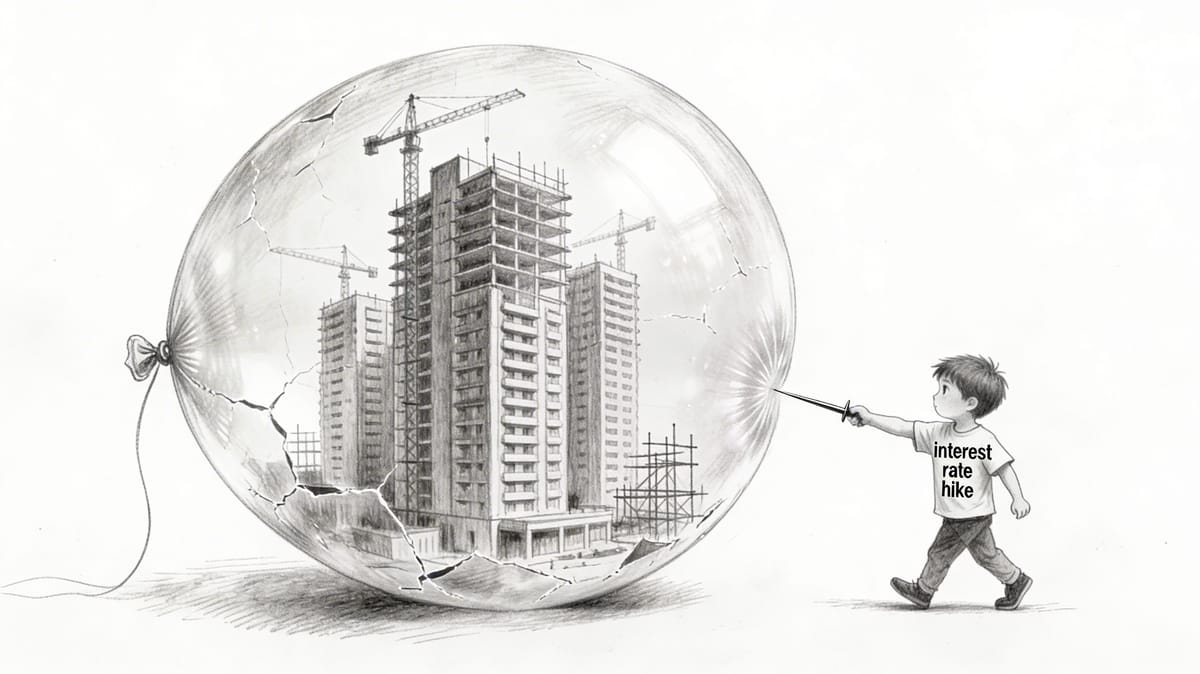
Signa Holding: €40 billion in creditor claims, one invisible assumption, and 18 months nobody used.
Entity: Signa Holding GmbH, Vienna. Real estate and luxury retail conglomerate. Filed for insolvency: November 2023 Debt at collapse: ~€13 bn in real estate assets; creditor claims exceeding €40 bn Time between cause and consequence: Approximately 18 months — from the ECB's first rate hike in July 2022 to insolvency filing in November 2023
January 2024. Signa's insolvency administrator is still mapping a corporate structure of approximately 1,000 entities. The full picture is not yet clear. What is clear is the assumption that collapsed under them — and why founders should care.
The Assumption
"The cost of capital is a background condition, not a strategic variable."
Signa's entire business model rested on one implicit bet: that the interest rate environment that made their deals profitable in 2018 would still be the interest rate environment in which they had to repay them in 2024. They did not hedge this. They did not plan around it. They borrowed as if rates were a fixed feature of the landscape, like gravity — not a policy variable controlled by a committee in Frankfurt that was, by mid-2022, visibly panicking about inflation.
This is not a real estate story. It is a story about what happens when a core business assumption is so embedded in the operating model that the organization can no longer see it as an assumption at all.
Why This Is a Founder Story, Not Just a Finance Story
You are not building a €13 billion real estate empire. But you are almost certainly carrying an assumption about cost of capital — or its startup equivalent — that you have never written down, never stress-tested, and never explained to your team.
The startup equivalents of Signa's assumption are things like:
- "We can always raise a bridge if we need more runway."
- "Our burn rate is fine as long as we keep growing."
- "Investors will be more patient once we hit the next milestone."
- "Our customers wouldn't switch — the switching costs are too high."
Each of these is a financing assumption dressed in operational language. Each of them can be true for 18 months and then become catastrophically false — not because anything about your business changed, but because the external environment changed and you had no margin for that.
The Reality Check
What actually happened at Signa, in sequence:
July 2022: The ECB raises interest rates for the first time in over a decade. This is not a surprise — inflation has been visibly accelerating since late 2021. Variable-rate debt immediately begins to cost more.
Late 2022: Signa's liquidity position begins to tighten. Construction payments on major projects — including the Elbtower skyscraper in Hamburg — start slipping. This is visible to contractors and subcontractors. It is not yet visible to the public or to all creditors.
Early-to-mid 2023: Banks begin internal reviews of collateral values on property-backed loans. Under ECB pressure, some lenders start marking down asset values — but slowly. Client relationship managers resist triggering covenant reviews on high-profile accounts. Internally at Signa, the assumption that markets will "normalize" persists in forecasting models.
Late 2023: Refinancing attempts fail. The gap between what assets are worth now versus what they were booked at becomes impossible to paper over. Elbtower construction halts publicly. Insolvency filed November 2023.
The gap: 18 months passed between a clearly visible macroeconomic event and its full organizational consequence. That gap was not luck or complexity. It was constructed — through model assumptions, relationship dynamics, corporate structure, and motivated reasoning.
The Time Horizon Mismatch
The interest rate assumption that broke Signa was borrowed from a different era entirely — and nobody labelled it as such.
In the 2010-2021 environment:
- Central bank rates were effectively zero or negative across the eurozone
- Variable-rate debt was cheap and refinancing was a routine administrative task
- Asset appreciation consistently outpaced financing costs
- A bad deal could be held until it became a good one
In the 2022+ environment:
- The ECB raised rates by 450 basis points over 14 months — the fastest tightening in the institution's history
- Variable-rate debt repriced immediately and continuously
- Asset values fell as capitalization rates rose — a mechanical consequence of higher yields
- The "hold until it improves" strategy required liquidity that was itself being squeezed by the same rate environment
The playbook was not wrong. It was from a different game. Signa played it anyway because the game had not officially been declared over.
For founders: The equivalent is applying a 2021 fundraising playbook in a 2023 market. The tactics are identical. The environment that made them work has inverted. Nobody sent a memo.
The Second-Order Consequence Cascade
Here is what makes the Signa collapse instructive beyond its size:
First-order effect: Rising interest rates increase debt service costs.
→ Second-order effect: Higher costs require either more revenue or asset sales to service debt. But rising rates also suppress asset values (buyers face the same cost of capital problem), making asset sales a losing proposition at exactly the moment they're needed most.
→ Third-order effect: The gap is filled with short-term liquidity instruments and refinancing — which themselves become unavailable as lenders recognize the deteriorating collateral values. The "solution" to the second-order problem accelerates the third-order collapse.
→ Fourth-order effect: Creditor panic becomes self-fulfilling. Julius Bär disclosed €606 million in exposure to Signa in January 2024, triggering executive resignations and a sharp share price fall — demonstrating that the collapse is contagious to counterparties who also had their own assumptions about collateral quality.
"The advice worked. That's why they failed." Signa's model of recycling capital through asset appreciation and cheap refinancing worked perfectly — until it created a structure so dependent on those conditions that any deviation became catastrophic.
For founders: If your growth model requires a specific financing environment to hold — either external (VC sentiment, interest rates, customer willingness to pay) or internal (burn rate staying flat, team not churning) — the second-order question is: what does the model do to itself when that environment shifts? Does it create the conditions for its own failure?
The Opaque Structure as a Risk-Amplification Device
Signa was not one company. It was approximately 1,000 interconnected entities across multiple European jurisdictions. This structure served legitimate purposes — tax optimization, project-specific financing, liability segregation — but it had a hidden cost: it made the consolidated risk picture invisible to almost everyone, including Signa's own senior leadership.
This matters for two reasons.
First, you cannot manage risk you cannot see. When the rate environment changed, there was no single dashboard showing total variable-rate exposure, total near-term debt maturities, and total liquidity across the group. The pieces were held by different entities, reported to different boards, and financed by different banks. By the time anyone assembled the full picture, the picture had already become an insolvency.
Second, opacity delayed creditor response. Banks with exposure to individual Signa entities did not have full visibility into total group leverage. They evaluated their piece against the collateral securing their piece — which still looked adequate in isolation even as the consolidated position was deteriorating rapidly. This is not stupidity. It is the predictable behavior of rational actors with incomplete information.
For founders: The startup equivalent is managing your business through a combination of separate spreadsheets, a Notion doc, a Stripe dashboard, and three different investor updates that each tell a slightly different story. You are not hiding anything intentionally. But when something goes wrong, you will not see it coming — and neither will anyone who might help you.
The Hidden Beneficiary Analysis
Who benefited from Signa's assumption persisting as long as it did?
The banks held performing loans against high-value collateral. Calling those loans or tightening terms would have required writing down collateral values — which meant recognizing losses on their own books. Extending credit to a distressed borrower is sometimes genuinely the rational thing to do. It is also sometimes a way of deferring a loss you will have to recognize eventually.
The construction sector — subcontractors, architects, engineers — continued receiving payments on active projects. Stopping work and filing claims is economically and reputationally costly. Every party with a contract had an incentive to believe the next payment would arrive.
The senior leadership of Signa had equity and reputation tied to the continued operation of the business. The assumption that rates would normalize was not irrational — it was directionally consistent with what Signa needed to be true.
The Signa assumption persisted not because everyone was foolish. It persisted because the ecosystem of parties surrounding it had short-term incentives to keep it alive, while the cost of the assumption being wrong was distributed across a much larger and more diffuse set of creditors and counterparties.
For founders: When you hear consistent reassurance from investors, advisors, and customers that your assumptions are fine — ask who has a financial incentive to believe that. Alignment of interest can look like validation.
Open Questions
These are not answered here. They are the questions worth sitting with.
On timing: If you had perfect information in July 2022 — knowing exactly how fast and far the ECB would raise rates — what would the rational restructuring of Signa's debt portfolio have looked like? Is there a version of this story where the same business survives? Or was the structure already irrecoverable at that point, and the 18 months of delay simply changed who bore the losses?
On cognition: Signa's leadership were not unintelligent. They had navigated complex capital markets for decades. What does it tell us that experienced operators, with professional risk teams and expensive advisors, systematically underestimated a risk that was visible in real time? Is this a story about cognitive bias — or about incentive structures that made clear thinking professionally costly?
On measurement: Signa's internal models marked asset values on historical or estimated bases, not current market clearing prices. How many months of false comfort did that buy? And if you're running a business with assets on your balance sheet — customers, contracts, IP, team — are you valuing them at what they would fetch today, or at what you need them to be worth?
On contagion: Julius Bär is not a real estate company. It is a Swiss private bank. It lost €606 million in the Signa collapse. Who in your ecosystem — investor, supplier, customer, partner — is carrying an exposure to your business that they have not fully priced? And what happens to them if your assumptions don't hold?
On the structural question nobody asked: Signa's complex corporate structure was presented as a feature — flexibility, efficiency, risk segregation. It turned out to be a risk amplifier. What complexity have you built into your own business that you're describing as a feature — and what does it look like under stress?
The Assumption Worth Examining in Your Own Business
Signa's fatal assumption — that the cost of capital is a background condition, not a strategic variable — translates directly to startup contexts as:
"The environment that makes our model work will continue to be the environment we operate in."
This assumption is invisible precisely because it's always been true, in your experience. Your runway calculations assume a fundraising market. Your pricing assumes a customer willingness-to-pay. Your hiring assumes a talent market. Your growth model assumes a distribution channel.
None of these are fixed. All of them can shift — and when they do, they often shift simultaneously, because they are all downstream of the same macroeconomic and market conditions.
Signa had 18 months between the moment its core assumption became false and the moment that falseness became undeniable. They used that time to refinance short-term, sell non-core assets at distressed prices, and issue increasingly optimistic public statements.
The question is not whether you have a Signa-style assumption embedded in your model. You almost certainly do. The question is what you would do with 18 months of warning if you could see it coming.
Destruction Desk
We perform autopsies on innovation’s failed assumptions.
This newsletter was edited by Manfred Lueth.
You received this email because you signed up for this newsletter from DestructionDesk.com.
To stop receiving this newsletter, unsubscribe or manage your email preferences