
The Backup Plan That Was Never Built
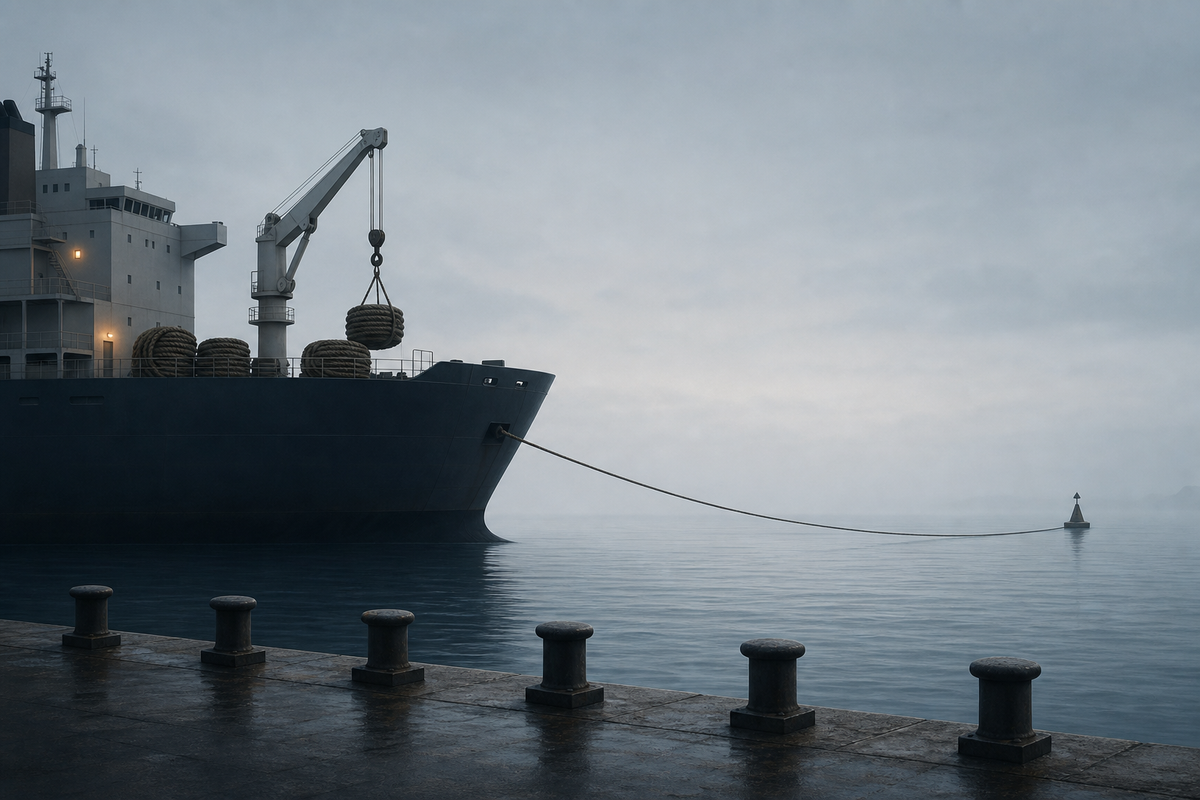
This has been in the news all week: Lufthansa's first Starlink-equipped Airbus goes live in exactly one week, on August 19. Good moment, then, to ask a question business usually skips before the champagne — which risks did we just make invisible? Let's start with Lufthansa. On January 1 3, 2026, Lufthansa Group announced that Starlink would be installed across nearly the entire fleet — roughly 850 aircraft, spanning Lufthansa, SWISS, Austrian Airlines, Brussels Airlines, and seven more carriers under the group. By 2029, every plane is meant to carry it.
The passenger-facing story is simple: fast wifi, free if you register a Travel ID. The story underneath is the one this issue is about.
The Assumption
A binding commercial contract with a single, exclusive infrastructure provider delivers the same resilience as owning a physical alternative. Sign the paper, get the guarantee.
The Reality Check
Germany believed something structurally identical about gas. Right up until February 2022, 55% of the natural gas Germany imported came from Russia — the largest share of any single supplier, delivered under long-term contracts that had held, more or less, for decades. In September 2018, Foreign Minister Heiko Maas told the public there was "no German dependence on Russia, certainly not in energy questions." By March 2022, his own successor as Economy Minister, Robert Habeck, was forced to admit: "The bitter news is: we still need Russian gas." The contracts hadn't failed. Politics overtook the contracts.
Taiwan drew the opposite conclusion from a smaller, quieter warning. In February 2024, a US congressman alleged that Elon Musk had withheld Starlink service in Taiwan — an allegation Musk denied, and which was never conclusively proven either way. Taiwan didn't wait to find out whether it was true. It committed $1.3 billion to build its own satellite network and diversified onto Luxembourg's SES and Europe's Eutelsat OneWeb, treating single-provider dependence as a cost to eliminate now, not a risk to insure against later.
The Hidden Beneficiary
Exclusivity is pitched to the customer as simplicity, cost, and performance. It is quietly worth more to the vendor. A single provider across an entire fleet — or an entire country's gas supply — doesn't just sell a product. It buys leverage: the ability to be the thing that cannot easily be replaced on short notice. Whether that leverage is ever used is beside the point. Its existence changes every future negotiation.
Lufthansa's own numbers make this concrete. Its previous connectivity system, the European Aviation Network, cost Lufthansa Group, Viasat, and Deutsche Telekom close to half a billion euros combined to equip 150 aircraft. Starlink is going onto roughly 850 — nearly six times the fleet, on newer, cheaper-per-unit technology. Neither Lufthansa nor SpaceX has disclosed the contract's value. Absent a public figure, "several hundred million to over a billion euros" is a defensible estimate of the deal's scale — an estimate, not a disclosed number, and worth treating as such until one of the two companies says otherwise.
That opacity matters more than it used to. SpaceX went public on June 12, 2026, priced at $135 a share, in the largest IPO in history — the same company Lufthansa is now betting an entire fleet's connectivity on. Public markets will start asking SpaceX for disclosures a purely private aerospace contractor never had to give. What that does to an airline customer's leverage in future contract renewals is untested.
What "Free" Is Actually Doing
Lufthansa is marketing the new wifi as free for anyone with a Travel ID. It replaces FlyNet, which used to cost passengers €6–8 short-haul and up to $27 long-haul. So "free" is real, in the narrow sense that Lufthansa is absorbing a cost it used to pass to the traveler.
What it also does is remove the one moment a passenger might have paused and asked why a single company's satellites now sit underneath their airline's entire onboard experience. A paid product invites scrutiny of what you're paying for. A free one rarely does. Frictionless is a good way to make a dependency invisible — not because anyone planned it that way, but because that is simply what "free" does to attention.
Open Questions
- What would Lufthansa's contract actually guarantee if Berlin and Washington had a serious diplomatic rupture?
- Taiwan spent $1.3 billion building its own satellite network rather than depend on one provider it couldn't control. Lufthansa is getting the equivalent service by having the airline absorb the cost instead of the passenger. What did Taiwan know that Lufthansa's procurement team didn't — or what is Lufthansa quietly assuming that makes the free version actually free?
- Germany assumed a state-controlled monopoly supplier was safer than a market of many. This time it's a single private supplier, now itself owned by public shareholders. Which assumption is riskier — and why did nobody ask that in January?
- Who else is making this exact bet on a single provider right now, and calling it prudent?
Sources & Dates: Lufthansa Group newsroom (Jan 13 & Aug 10, 2026); Runway Girl Network (Jan 16 & Feb 13, 2026); Business Traveller (Aug 2026); Clean Energy Wire and Brookings on German gas dependence (55% pre-Feb 2022); Internationale Politik Quarterly on Maas/Habeck statements (2018/2022); Broadband Breakfast / Reuters on Taiwan's $1.3B satellite investment and the Feb 2024 Musk allegation; SmartAsset/Forbes/Capital.com on the SpaceX IPO (June 12, 2026).
Destruction Desk
We perform autopsies on innovation’s failed assumptions.
This newsletter was edited by Manfred Lueth.
You received this email because you signed up for this newsletter from DestructionDesk.com.
To stop receiving this newsletter, unsubscribe or manage your email preferences
Comments ()