The Demo Closes One Argument and Opens Another (4/6)

This newsletter is a six-part sequence built on one anchor: AI is compressing the prototyping cycle — but faster technical iteration without parallel commercial assumption-testing doesn't reduce risk, it accelerates the gap. Perspective 4 takes that gap from one specific angle: the demo closes one argument and opens another. Each edition puts one assumption under the knife. None of them end with a fix. The terrain is the point — you locate yourself in it.
The Assumption
A successful demo moves the deal closer to close, on the same terms and with the same people who watched it.
The Reality Check
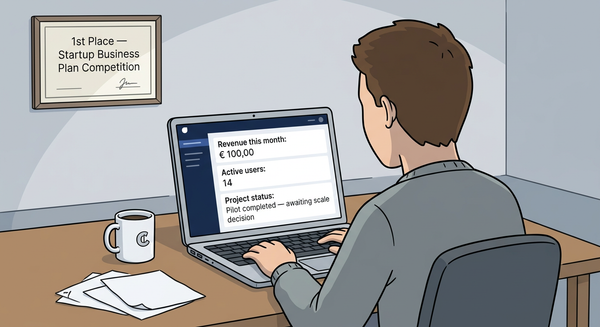
The demo went well — everyone in the room agreed it worked. Nine weeks later, the budget owner asked a question about deployment that nobody in that room had been positioned to answer.
The Forensic Analysis
HQ and R&D functions do hold real budget at this stage — for breakthrough bets, fleet-level pilots, standardization programs, early-TRL experimentation. That budget is genuine, and a strong demo is a legitimate way to unlock more of it. What it isn't is sufficient on its own. This series' opening edition cited McKinsey's finding that fewer than one in ten pilots make it from pilot to scale (Technology Trends Outlook, 2024) — and a demo sits at an earlier readiness level than a pilot, typically closer to a working prototype shown in a controlled setting than a system proven in its actual operating environment. Whatever attrition happens between pilot and scale still lies ahead of a technology that has only reached demo stage. A successful demo is an encouraging sign that something might eventually cross the valley of death. It says nothing about the odds of the harder stages still ahead of it.
The determining factor isn't only who was physically in the room, and it isn't only which criteria govern the decision either — both operate at once, which is exactly why this doesn't reduce to a simple deal. Forrester's 2026 buyer research puts the typical business buying decision at 13 internal stakeholders and 9 external influencers, with procurement holding decision-making power in 53% of cycles and involved from the start (Forrester, The State of Business Buying, 2026). That headcount complexity compounds the criteria problem, it doesn't substitute for it: a demo is judged on whether the thing works; deployment is judged on cost, time, and operational performance, criteria that belong to whoever holds P&L for the unit that has to run it. Operative people are often in the demo room too — running tasks, fielding technical questions — but their presence doesn't mean their scorecard was the one the demo was built to satisfy. Buying an innovation isn't like ordering a photocopier. It moves through more people and more criteria at once, precisely because of what it implicates across the organization.
Open Questions
Agency
- After a successful demo, whose approval standard actually governs what happens next — and is it the standard the demo was judged against?
- Who has the standing to keep pushing this technology forward after the demo, and who has more to lose if it stalls?
Functional
- What did the demo actually prove — and what was it never in a position to prove?
- If the next round of funding comes from HQ or R&D rather than the operating unit, what does it buy: broader testing, or deployment?
Destruction Desk
We perform autopsies on innovation’s failed assumptions.
This newsletter was edited by Manfred Lueth.
You received this email because you signed up for this newsletter from DestructionDesk.com.
To stop receiving this newsletter, unsubscribe or manage your email preferences