The Gap Has an Owner
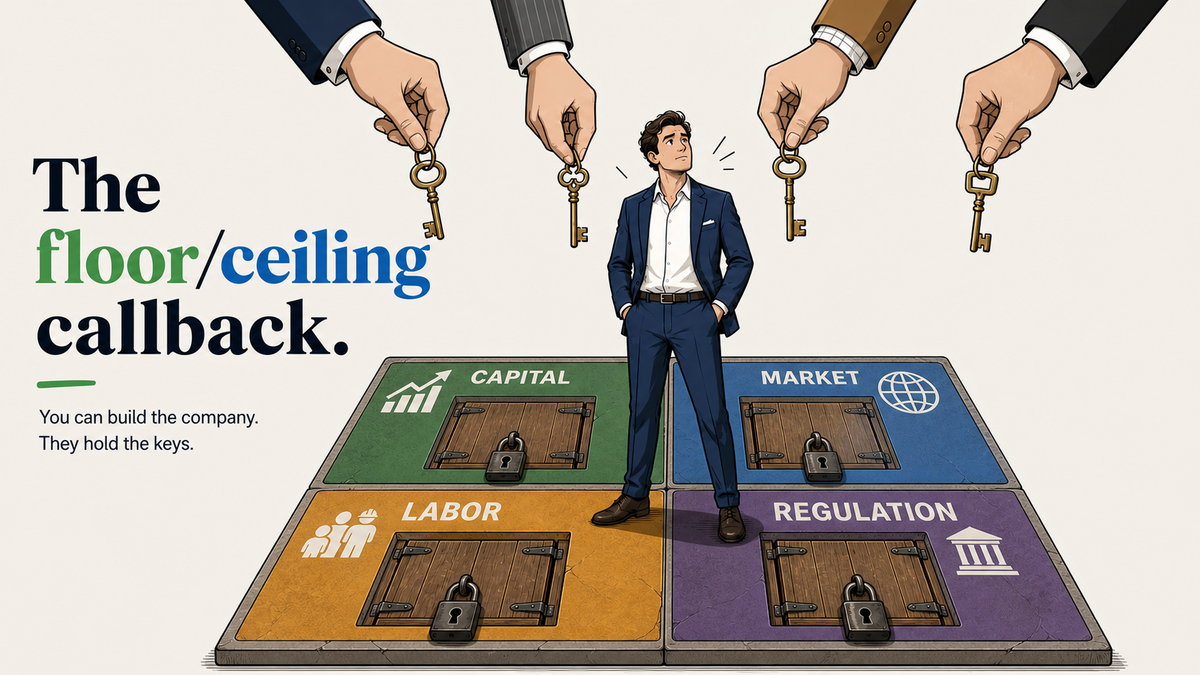
Yesterday, Apollo's chief economist Torsten Slok posted in his daily spark newletter four reasons the United States remains "the best place to build a company": easier access to capital, a bigger market, a labor market that lets firms resize quickly, and lighter regulation that lets companies pivot fast.
Read cold, that list lands as a verdict on Germany. Every founder here has heard some version of it — from an investor, a politician, or their own doubt at 2am. Capital: thin. Market: fragmented into 27 pieces. Labor: rigid. Regulation: a permitting timeline measured in years. The conclusion politicians reach, especially in August when parliament is on holiday and nothing moves: it cannot work here, not at the pace the US moves.
**The Assumption:** that these four gaps are neutral facts nobody controls — weather, not policy. In reality, each one was set by a specific institution that could move it, and is being paid for by a different group who never made that choice. Naming which is which is the point of this issue.
## The Reality Check — And Who Holds Each Lever
Take Slok's four factors one at a time, with sourced numbers, and with the deciding institution named instead of implied.
**Capital access.** Real — and not really a trustee's choice. Between 2014 and 2023, EU venture capital totaled roughly €89 billion against more than €1,000 billion in the US, for economies of comparable size. European pension funds allocate 2–3% of assets to venture; US pension funds allocate 8–10%. That gap is not European caution. Germany's Investment Ordinance (Anlageverordnung) caps the combined "risk investment quota" for pension funds and smaller insurers at 40% of assets — raised from 35% only in February 2025 — covering all higher-risk holdings together, not venture capital specifically. Larger insurers under Solvency II face no hard quota, but capital charges that make illiquid, high-risk assets like venture capital expensive to hold. A pension trustee operates inside that ceiling. The regulator who sets it, and the legislator who could raise it, hold the actual lever. *(Sources: CEPR/Banque de France, 2025; Dechert and BCLP legal updates on the AnlV amendment, Feb 2025.)*
**Market size.** Also real, and also a choice, not a geography problem. The Draghi report's line still stings: no EU company above €100bn market cap has been built from scratch in fifty years, while all six US companies above €1 trillion were. The EU is nominally a market of 450 million people. It behaves like 27 markets because 27 national governments have not agreed to one EU-wide company code, insolvency regime, and tax treatment — a "28th regime" proposed repeatedly and stalled each time in the Council. Founders are not short of customers. They are short of a decision that sits with national governments, not with them.
**Labor market flexibility.** Real, and set in one specific law: Germany's Kündigungsschutzgesetz (dismissal protection act) and its collectively bargained extensions, which only the Bundestag can amend. The OECD's own employment protection index shows the result — the US sits among the least-restrictive dismissal regimes it tracks; Germany sits above the OECD average. That same protection gives German firms lower staff turnover and more retained know-how, an advantage founders can use deliberately. But resizing a team costs more time and money here than Slok's US chart assumes, and that cost is set in Berlin, not by the market.
## Regulation: The Clearest Price Tag, and the Clearest Owner
The ifo Institute puts Germany's bureaucracy cost at up to €146 billion a year in lost output — about 4% of GDP — more than double the National Regulatory Control Council's own estimate of direct compliance costs. Companies have hired roughly 325,000 extra staff since 2022 just to handle compliance.
**[CHART: "Germany's Bureaucracy Bill: Three Numbers, One Study" — upload `ifo_chart.png` as the featured/inline image here]**
*Source: ifo Institute press release, Nov 14, 2024 — [ifo.de/en/press-release/2024-11-14](https://www.ifo.de/en/press-release/2024-11-14/bureaucracy-germany-costs-146-billion-euros-year-lost-economic-output)*
Every euro in that chart is inside the reach of federal and state legislators and administrators — ifo's own recommendation is to catch up to Denmark's level of digitalization. This is not a fact of German life. It is a backlog with a named owner who has not cleared it.
Who Holds Each Lever — and Who Pays While It's Not Pulled
Every one of these four gaps has a specific decision-maker who could move it, and a different group who bears the cost while it stays put:
- Capital access — lever: AnlV and Solvency II regulators, EU capital-markets-union legislators. Cost falls on: founders who can't raise growth capital domestically.
- Market size — lever: national governments blocking a single EU company code. Cost falls on: founders forced to fragment operations across 27 jurisdictions.
- Labor flexibility — lever: the Bundestag, via dismissal law. Cost falls on: founders who over-hire cautiously or stall rather than resize.
-Regulation — lever: federal and state regulators, per ifo's own recommendation. Cost falls on: SMEs, which the ifo study shows carry the heaviest relative burden.
None of these four has closed materially in the years each has been publicly measured. That is not because no one knows the fix. "It cannot work here" is a more comfortable sentence for a regulator or a national government than "we set this ceiling, and we have not moved it." The AnlV quota moved 5 points in a decade. The single EU company code has been proposed and stalled for longer than most readers of this newsletter have been building companies. "It cannot work" is not a diagnosis of Germany. It is cover for the small number of institutions that hold each lever.
The Choice Nobody Priced as a Risk: Energy
There is a fifth gap Slok does not need to name, because the US does not carry it. It gets its own line here because it was not a market outcome — it was two decisions, made by Germany's federal government and legislature, treated as though they carried no probability of failure.
In 2021, Russia supplied 55% of Germany's natural gas imports. That share was not hedged as a risk; it was budgeted as a baseline. In the same period, Germany completed a nuclear phase-out first legislated in 2011 and finished in April 2023 — reaffirmed several times, including once during the 2022 gas crisis itself, without a funded plan to replace the lost generation at comparable cost. Both decisions sat with the Bundestag and the federal ministries that repeatedly confirmed them. The bill is now paid by German industrial energy users, who face some of the highest retail electricity prices in Europe, and by the pace of the phase-out, whose lost nuclear output was replaced disproportionately by coal in the near term, not renewables.
A founder who ran a business plan this way — single supplier for a critical input, no contingency budget, the plan reconfirmed under stress instead of re-examined — would be told by any investor to fix it before a term sheet. German energy policy ran exactly that plan at national scale, in public, for over a decade. The lever sat with elected government the entire time.
Open Questions
Germany loses €146 billion a year to bureaucracy. Governments have known this for two years. What needs to happen before a government spends real effort to fix it, not just talk about it?
If the EU replaced 27 company laws with one, some group would lose an advantage. Who is that group? Is it founders — or someone else?
Imagine every EU country waited for another country to fix its own version of these problems first. Would the EU still work? Or does it only work today because most countries are not waiting at the same time?
Slok says four factors explain why the US wins. Is that the whole story? Or does the US also win because it delayed fewer hard decisions than Europe did?
If Germany fixed its bureaucracy and capital gaps tomorrow, some of today's advantages could disappear — for example, low wholesale energy costs for some users, or a founder pool with less outside competition. Who benefits from these problems staying unfixed?
Destruction Desk
We perform autopsies on innovation’s failed assumptions.
This newsletter was edited by Manfred Lueth.
You received this email because you signed up for this newsletter from DestructionDesk.com.
To stop receiving this newsletter, unsubscribe or manage your email preferences
Comments ()