
The 'Deep Tech' Prototyp Trap
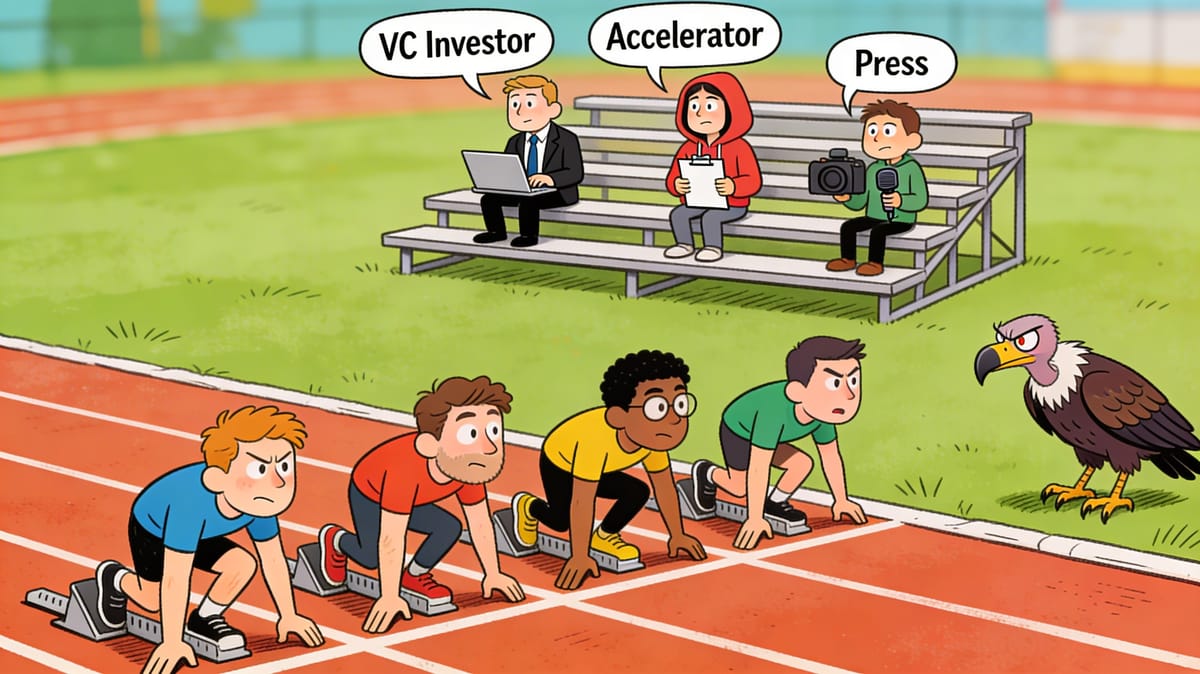
Why 'you've proven the technology' is the sentence that kills more deep tech founders than any other.
The Assumption
You built something that works. In the lab, on the bench, in the demo room — it actually works. The investors in the front row have just seen it. One of them leans over and says the words you have been waiting eighteen months to hear:
"Your prototype proves the technology. Now raise and scale."
It feels like arrival. The hard part is over. The science is done. What remains is execution — hiring, fundraising, shipping. You leave the demo day thinking the valley is behind you.
It isn't. For most deep tech founders, the valley starts here.
The Reality Check
Technology Readiness Levels (TRLs) were developed by NASA in the 1970s as a framework for understanding how far a technology actually is from deployment. The scale runs from 1 (basic principles observed) to 9 (system proven in operational environment). A working prototype — the kind that generates standing ovations at demo days — typically lands between TRL 4 and TRL 6.
TRL 6 is not close to TRL 9. Between them sits a chasm that has no accepted name in startup culture, no standard funding instrument, and no reliable timeline. It is the place where technologies that work in controlled conditions encounter the reality of manufacturing tolerances, supply chain constraints, regulatory environments, and operational stress that no lab can simulate.
The data on what it costs to cross this chasm is stark. Moving from TRL 5 to TRL 6 can cost multiples of everything spent from TRL 1 to 5 combined. The step from TRL 6 to TRL 7 — demonstrating a prototype in an actual operational environment — is larger still, requiring facilities, partnerships, and timelines that most seed and Series A financing structures are not designed to support.
This is not a gap in founder ambition. It is a structural mismatch between what the deep tech development process requires and what the startup funding ecosystem is designed to provide.
Who Profits When Founders Believe This?
The prototype-as-proof assumption did not emerge in a vacuum. It is actively maintained by a set of institutional actors who benefit from it — not through malice, but through incentive structures that systematically reward the wrong signals.
Accelerators and demo day programs
An accelerator's output is visible at demo day. A working prototype is something an audience can see, a press release can photograph, and a success story can anchor. The eighteen months of grinding between TRL 6 and TRL 7 is invisible — it produces nothing that fits a graduation stage. Accelerators are not incentivised to prepare founders for the valley; they are incentivised to produce compelling demonstrations of early-stage potential. The two are not the same thing.
Early-stage venture capital
A VC who invests at TRL 5 can mark up their position at TRL 6 based on the working prototype. That valuation increase is real for their fund reporting — even if the company is nowhere near revenue. The prototype creates a paper win that helps the fund's internal metrics, raises the profile of the investment, and enables the next fundraising cycle. Whether the company can cross the TRL 6-to-9 gap is a problem for the next fund. This is not cynicism — it is the logical consequence of a mismatch between the timeline of the fund structure with the development timeline of the technology venture.
Technology press and innovation media
A prototype demonstration is a story. An 18-month slog through supply chain qualification, tolerance testing, and manufacturing process development is not. The coverage cycle for deep tech startups clusters heavily around fundraising rounds and prototype reveals — precisely the moments when the technology looks most impressive and the hard questions are furthest away. Founders learn, consciously or not, to time their press for TRL milestones rather than for commercial readiness. This reinforces the narrative that the prototype is the achievement.
The demo day industrial complex does not celebrate what happens after demo day. Founders are left holding an assumption that everyone in the room helped create — and that none of them will be present to dismantle.
Founder cost
While founders focus on the fundraising narrative that a working prototype enables, they typically underinvest in three things that will determine whether they survive the valley: manufacturing readiness assessment, operational environment testing, and the capital structure needed to bridge a 24-to-48 month gap with no revenue. By the time the gap becomes visible, the runway is already short.
The Wrong Game, Played Convincingly
The prototype-as-proof assumption can be tracked back to the software and SaaS analogy, where it was and remains essentially correct.
In software, a working prototype does prove the core technology. The gap between a functional demo and a shipped product is largely an engineering and resourcing question. Iteration cycles are measured in days or weeks. Capital requirements are low. Failures are reversible — a bad product release can be patched, pivoted, or abandoned without destroying the company. The advice 'you've proven the technology, now scale' is directionally accurate in this context.
In deep tech hardware, none of these conditions hold:
– Iteration cycles are measured in months or years, not days
– Capital requirements for moving from TRL 6 to TRL 7 can be in the millions
– Failures at scale can be catastrophic and irreversible — a manufacturing defect discovered at volume costs orders of magnitude more than one discovered in the lab
– The 'technology' at TRL 6 is not the same technology as at TRL 8. Each level of environmental and operational complexity reveals failure modes that laboratory conditions structurally cannot surface
The temporal gap creates a specific trap: founders raise capital on a TRL 6 timeline (12-18 months to the next milestone) using investor expectations formed in software (where 12-18 months genuinely does get you to market). The mismatch is not discovered until the capital is deployed and the milestone is not reached.
This is not a founder failure. It is an assumption failure — one that was imported from a different game and applied to conditions where it does not hold.
The Forensic Analysis: What Actually Killed Them
The evidence from recent deep tech failures is consistent enough to constitute a pattern.
Rain AI: the celebrated prototype that found no path to scale
Rain AI raised over $146 million to build neuromorphic AI chips, with backing from figures including Sam Altman. In 2021, the company taped out its first working prototype chip — a genuine technical achievement. Sam Altman's public statement at the time noted that Rain had accomplished 'what most companies require much more capital to do.' The company was named to a 2024 Startups to Watch list. By May 2025, Rain was seeking a buyer after its funding efforts stalled. The cause was not the technology — the prototype worked. The cause was what the prototype did not prove: fabrication at scale, reliability under operational conditions, and a viable path through the gap between a working chip and a commercially deployable product. A single tape-out costs millions. Rain's working prototype was the beginning of the expensive part, not the end of it.
Canoo: $2.4 billion valuation, 22 vehicles delivered
Canoo went public via SPAC in December 2020, raising $600 million and reaching a valuation of $2.4 billion on the strength of its prototype — a distinctive, boxy lifestyle van that attracted attention from Apple, Walmart, NASA, and the US Army. The order book eventually exceeded $3 billion. In January 2025, Canoo filed for Chapter 7 bankruptcy with less than $50,000 in assets against liabilities of up to $50 million. In 2024, the company delivered 22 vehicles. The prototype did prove the design concept. It did not prove the manufacturing economics, the capital structure required to reach volume production, or the operational reliability needed to honour fleet contracts. The valley between the prototype and the product consumed the company entirely.
The pattern holds across sectors
The 14 grid-scale battery companies that failed post-Series A between 2022 and 2025 had largely validated technology. The 7 cell therapy companies that shut down in 2024 despite FDA breakthrough designation did not fail on efficacy — they failed because their contract manufacturers could not scale production beyond 50 patient doses per quarter. In each case, the prototype proved the science. It did not prove the system.
The prototype proved that the technology works in the conditions under which it was tested. Those conditions are rarely the conditions under which it will need to work commercially.
The Second-Order Consequence Cascade
The assumption does not just create immediate problems. It creates delayed failures that are harder to attribute — and therefore harder to learn from.
First-order effect: the working prototype unlocks a funding round on a compressed timeline.
Second-order effect: the funding round is structured around software-style milestones (12-18 months to market) that are incompatible with deep tech development cycles. The founder accepts these terms because the alternative is no capital at all.
Third-order effect: when the milestones are not reached, the founder is characterised as having 'execution problems' or 'lost focus.' The structural mismatch between the funding instrument and the development reality is not recorded. The next deep tech founder receives the same advice from the same investors — because the assumption that generated the failure was never surfaced as the cause.
The advice worked, in the narrow sense that it secured the funding round. That is precisely why the cycle repeats.
Counterfactual Scenarios
These scenarios are not prescriptions. They are questions made concrete — intended to surface the assumptions embedded in the standard path.
Scenario A: What if the funding round had been structured around TRL milestones rather than calendar milestones?
Instead of '18 months to commercial launch,' the terms gate capital tranches on TRL progression: TRL 6 unlocks tranche one, TRL 7 (operational demonstration) unlocks tranche two, Manufacturing Readiness Level 4 unlocks tranche three. The timeline is longer. The capital is deployed more slowly. But the founder is not forced to claim readiness they do not have in order to meet investor expectations formed in a different industry. Would Canoo's trajectory have looked different? Would Rain AI have had the runway to complete fabrication qualification? We cannot know — but the question is more useful than the assumption it replaces.
Scenario B: What if 'proving the technology' required an operational environment test, not a lab demonstration?
Several sectors already require this. FDA Class II medical device clearance requires clinical validation, not bench testing. Military procurement via OTA contracts requires operational demonstration before purchase. These processes are slower and more expensive than demo days — and they produce a qualitatively different kind of proof. If deep tech investment culture required TRL 7 (prototype demonstrated in operational environment) rather than TRL 5-6 as the threshold for Series A, which companies would have been funded? Which would have been asked harder questions earlier, when they still had the capital and time to answer them?
Scenario C: What if we measured 'success' differently at the prototype stage?
The standard success metric at demo day is: does it work? An alternative metric: what are the three failure modes this prototype has not yet encountered, and what would it cost to surface them? This is not a comfortable question to ask in a room where investors are deciding whether to write a check. But it is the question that determines whether the prototype is a proof of concept or a proof of product. The companies that survived the valley — Anduril, Form Energy, Commonwealth Fusion — shared a common characteristic: they treated the prototype as the start of the risk-identification process, not the end of it.
Open Questions
This section does not offer answers. It offers questions that the standard narrative makes it easy to avoid.
On measurement:
– What would you need to demonstrate — beyond a working prototype — to know whether your technology is actually ready for the next development stage?
– If you mapped your current TRL against your funding runway, at what TRL does your capital run out?
– What failure modes does your prototype not yet know about — and what would it cost to find them before your investors do?
On incentives:
– Who in your current ecosystem benefits from you believing the hardest part is behind you?
– If your lead investor's fund structure runs to 7 years and your development timeline runs to 10, who is bearing the risk of that mismatch?
– What becomes harder to fundraise if the gap between TRL 6 and TRL 9 is made explicit in your pitch?
On timing:
– The advice you are receiving — raise on prototype, scale fast — was largely formed in a software context between 2010 and 2020. What changed in your sector that would require different advice?
– What will the TRL 6-to-9 gap cost in your specific domain? Has anyone you trust actually modelled this number?
– If your manufacturing process is not yet defined, what exactly are you scaling?
On comparison:
– Which companies in your sector successfully crossed the valley — and what did they have at TRL 6 that made the crossing possible?
– Which companies had better prototypes, more capital, and stronger order books than you — and still did not make it?
– If you designed your development process around the assumption that the prototype is the beginning of the hard part, what would you do differently starting tomorrow?
A final note on the limits of this autopsy:
This analysis does not argue that deep tech is unfundable, that demo days are worthless, or that working prototypes are meaningless. It argues that the narrative built around the prototype — 'you've proven the technology, now scale' — systematically understates what remains to be proven, and that the institutional actors who repeat this narrative are not neutral observers.
The founders who navigated the valley successfully were not luckier or smarter than the ones who did not. They were, eventually, precise enough about what their prototype had proven and more honest — with themselves and their investors — about what it had not.
That precision is not pessimism. It is just accuracy about where you are. The founders who made it through the valley were not more optimistic than the ones who didn't — they were more specific about what they didn't yet know, and who had agreed to fund the finding out. The prototype answered one question. The valley is made of all the ones it didn't.
Destruction Desk
We perform autopsies on innovation’s failed assumptions.
This newsletter was edited by Manfred Lueth.
You received this email because you signed up for this newsletter from DestructionDesk.com.
To stop receiving this newsletter, unsubscribe or manage your email preferences