
India Didn't Fund Deep Tech. It Redefined It. There's a Difference.
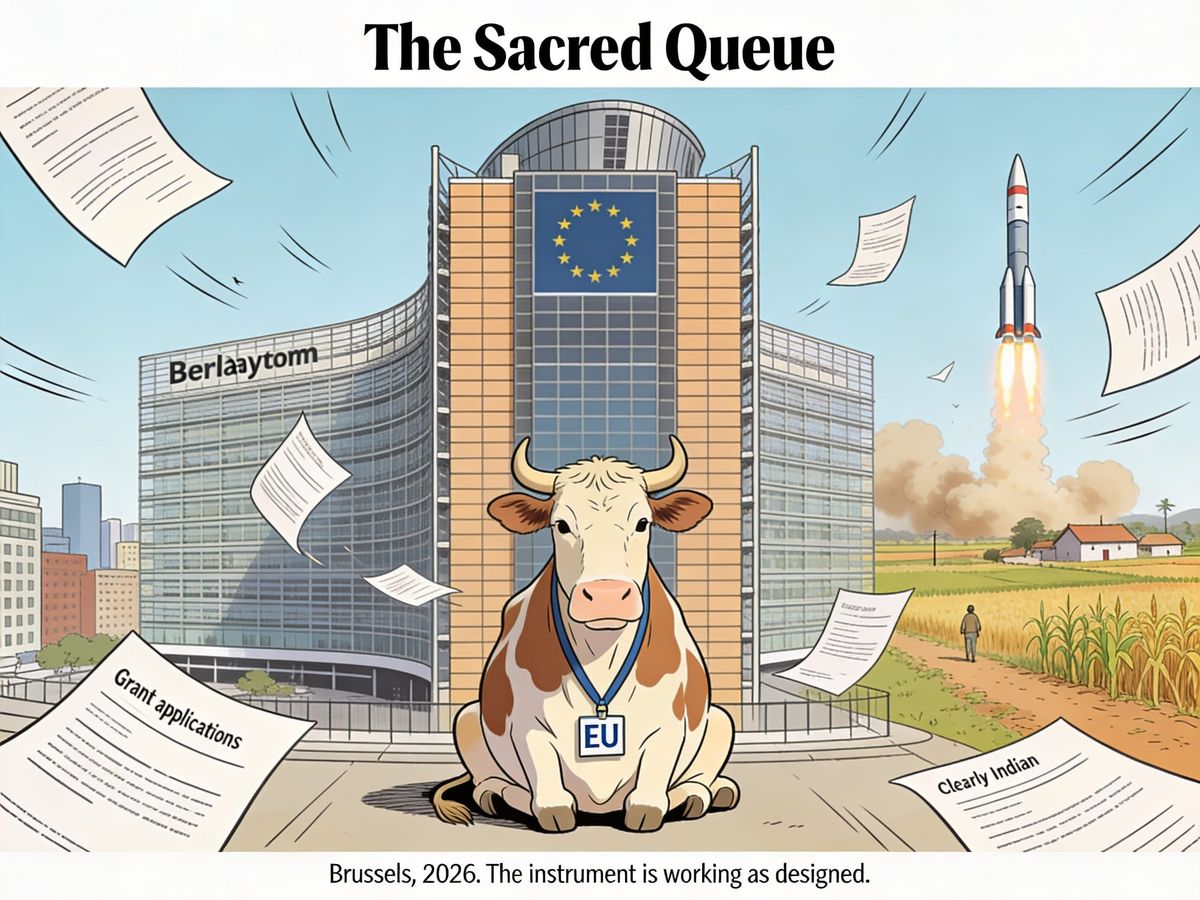
India rewrote a definition. Europe launched another fund. One of these will matter in 2035.
Two weeks ago we examined why capital conditions have structurally shifted and will not reverse. Last week we examined why Germany’s capital went into the wrong category. This week: what happens when the instrument itself is the problem — regardless of how much capital flows through it.
THE ASSUMPTION
Governments support deep tech innovation through grants, subsidies, and funding programs. The more capital deployed, the stronger the signal of political commitment. The budget is the instrument. Disbursement is the metric.
This assumption is so structurally embedded in European innovation policy that questioning it reads as beside the point — a misunderstanding of how the system works, not a critique of it.
The EU has moved aggressively on this front — in part because it has little choice. Private capital in Europe is structurally underweighted toward deep tech, and programs like the EIC Accelerator, Horizon Europe, and the STEP Scale Up scheme exist to fill a gap that institutional investors are not filling. Each one is real. Each one is substantial. Each one operates on the same underlying logic: identify promising companies, select them through evaluation, transfer capital, measure outcomes.
What if the instrument is outright wrong — not the intention, not the people administering it, not the volume of money, but the instrument itself?
THE REALITY CHECK
On February 4, 2026, India’s Department for Promotion of Industry and Internal Trade issued a Gazette Notification replacing its entire startup recognition framework. The headline reform: a formally defined “Deep Tech Startup” category, with an extended recognition window of 20 years and a turnover ceiling of ₹300 crore (~USD 33M) — compared to 10 years and ₹100 crore under the 2019 regime.
No new fund was created. No evaluation committee was convened. No budget line was opened. A definition was rewritten. The clock was reset.
The previous framework had created what practitioners were already calling the “graduation cliff.” A biotech company in year 11 of clinical trials, a semiconductor venture in year 12 of R&D — both would lose startup recognition status, and with it tax exemptions, procurement access, and the investor signal that formal recognition provides, at the precise moment their capital requirements were highest and their revenue was still zero. The policy judged science-led ventures on bureaucratic timelines, not technological ones.
The 2026 notification corrected the unit of measurement. Deep tech recognition is now tied to demonstrable R&D expenditure, IP creation, and documented technological uncertainty — not the calendar date of incorporation.
The private capital response was not slow. Within weeks, a $2 billion commitment from US and Indian VC and PE firms — including Accel, Blume Ventures, and Celesta Capital, with Nvidia as adviser — was mobilized specifically for deep tech. The policy change did not deploy that capital. It made the capital legible to investors who had previously faced an expiry date on their risk horizon.
THE COMPLIANCE PARADOX
The EU equivalent of the graduation cliff is not hypothetical.
European deep tech ventures typically require 10–15 years to translate research into commercially viable products. This is documented, not contested. McKinsey’s analysis of the European deep tech market (2024) confirms that deep tech ventures require up to 40% more funding to reach revenue stage than conventional tech companies — while generating superior returns once they do, averaging 17% net IRR versus 10% for traditional tech funds.
The EIC Accelerator, Europe’s flagship instrument, operates on grant-plus-equity rounds evaluated in cycles. EIC support timelines, compliance requirements, and reporting obligations are calibrated to innovation cycles that look nothing like semiconductor development or pharmaceutical-grade biotech. Companies that engaged most fully with EU support programs — that complied most rigorously — did so at the cost of engineering and commercial bandwidth, calibrated their growth to program timelines, and still hit national-level SME definition ceilings that terminated their access to targeted support before commercialization.
The companies that followed the rules fastest lost the most time.
THE HIDDEN BENEFICIARY ANALYSIS
Who profits when innovation policy is delivered as grants rather than structural reform?
Grant programs require evaluation committees to assess applications. Program offices to manage disbursement. Reporting systems to track compliance. Audit functions to verify outcomes. Intermediary organizations to support applicants through the process. Accelerators positioned as feeders into the funnel. This infrastructure is not corrupt — it is genuine — but it is also self-sustaining. The instrument generates institutional activity that is independent of whether the instrument works.
A definitional change of the kind India executed on February 4, 2026 requires one gazette notification. It produces no ongoing institutional revenue. It requires no evaluation committee, no reporting cycle, no compliance infrastructure. It is, from an administrative standpoint, almost invisible.
The asymmetry is structural. Grants are visible. They produce press releases, allocation announcements, political credit, and year-on-year budget comparisons. A redefined recognition window appears in a government gazette and is read primarily by lawyers and founders. The political economy of the two instruments is not equivalent — and that difference shapes which one gets chosen.
THE SECOND-ORDER CONSEQUENCE CASCADE
A deep tech company loses EU startup recognition status in year 11, pre-revenue. Trace what happens next.
First-order effect: loss of tax exemption and formal startup status. Immediate and documentable.
Second-order effect: existing investors face a reclassified risk profile for a company that has not changed its underlying technology or commercial trajectory. New investors evaluating entry see a company that has “graduated” — the label implies maturity and revenue readiness that does not exist. The information asymmetry works against the founder in every subsequent negotiation.
Third-order effect: the company restructures or relocates. Not because the technology failed. Not because the market disappeared. Because the policy clock ran out. Between 2019 and 2025, an estimated 60% of European scaleups that relocated outside the EU cited regulatory and administrative complexity as primary factors. The policy designed to support them accelerated the departure.
The grant that kept them solvent in year 7 did not offset the structural reclassification that made them uninvestable in year 11.
THE PARALLEL DOMAIN — WHAT INDIA’S EXPERIMENT ACTUALLY TESTED
India’s reform is not a theoretical proposition. It is a live policy experiment with a known date of execution: February 4, 2026.
The prior framework had produced a documented result: nationally, only approximately 10% of India’s recognized startups were classified as deep tech under the 2019 regime. Ninety percent of startup support flowed through a single undifferentiated category that treated a two-year-old SaaS company and a nine-year-old quantum computing venture identically. The framework did not distinguish between them because it had no definition that required it to.
The 2026 notification introduced an attribute-based definition: eligibility for deep tech recognition requires demonstrable R&D expenditure, IP creation, and documented technological uncertainty. Not a sector label. Not a founding date. The actual characteristics of the innovation.
This is the comparison that EU policy has not yet made explicit: its own definitions of “innovative startup” and “innovative scaleup,” adopted in the March 18, 2026 Recommendation accompanying the EU Inc. framework, harmonize categories across 27 member states. Whether they differentiate the recognition timeline by innovation type — whether a biotech company in year 14 of development is treated differently from a SaaS company in year 3 — is not stated in the public summary of that Recommendation.
That gap is not a detail. It is the question.
OPEN QUESTIONS
The following questions do not have answers here. That is the point.
If a deep tech company loses startup recognition in year 11 while still pre-revenue, what signal does that send to its current investors — and what does it cost a new investor to recalibrate that signal before entering?
The EU Inc. Recommendation of March 18, 2026 introduces common definitions for innovative enterprises, innovative startups, and innovative scaleups across 27 member states. Does it differentiate the recognition window by innovation type, or does it apply uniform timelines regardless of TRL stage and development cycle length?
India tied its definitional reform to IP creation and R&D intensity — not sector labels. The EU SME definition remains primarily revenue- and headcount-based. What does a revenue ceiling measure in a company that has not reached revenue by design?
Grant programs require ongoing institutional infrastructure to administer. A definitional change requires a gazette notification. Why, consistently across EU member states, is one the preferred instrument?
If the €300M STEP Scale Up 2026 budget were replaced by a 20-year deep tech recognition window — with zero disbursement — which intervention would generate more patient capital formation over a 15-year horizon? Has anyone modeled that comparison?
Which EU member state is structurally closest to executing the definitional reform India ran on February 4 — and what is the specific obstacle preventing it?
Was the graduation cliff a design failure — or a feature that served someone?
Destruction Desk
We perform autopsies on innovation’s failed assumptions.
This newsletter was edited by Manfred Lueth.
You received this email because you signed up for this newsletter from DestructionDesk.com. To stop receiving this newsletter, unsubscribe or manage your email preferences.
Comments ()