When Rules Become Deals: How the EU’s Cupra Exemption Erodes Trust in the Single Market
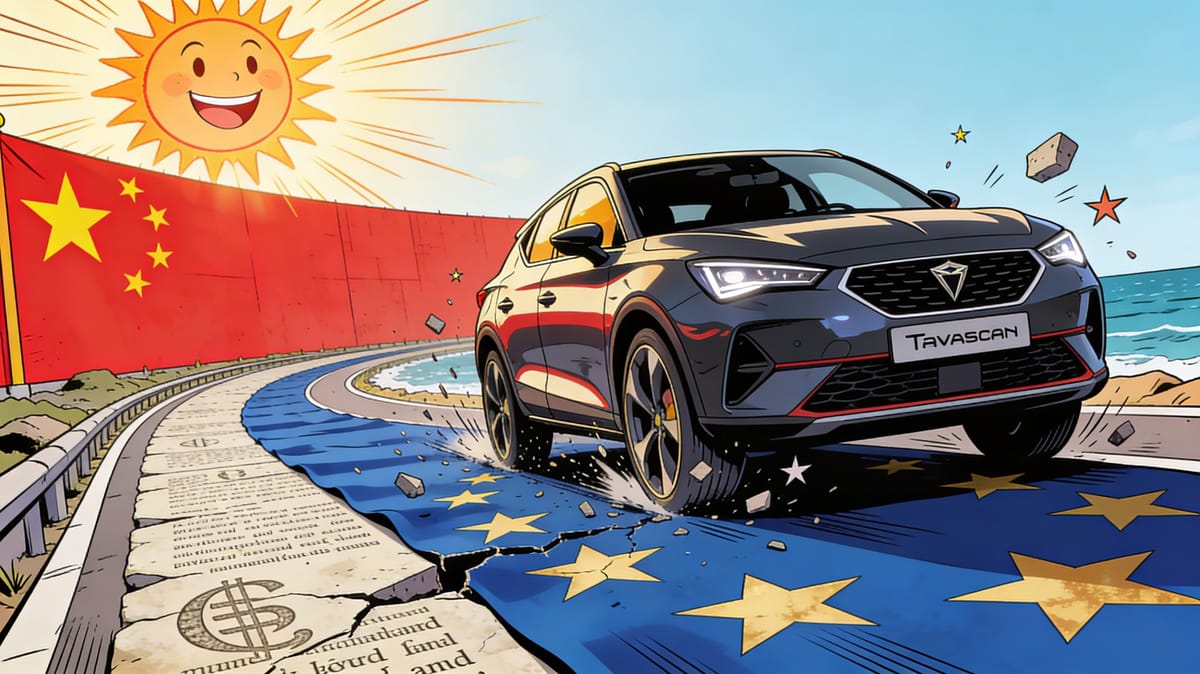
You've been told the single market runs on rules. The Cupra* exemption shows how fast it can shift back to deals.
*High performance brand from SEAT (VW Group)
1. The Assumption
The comforting story goes like this: trade law in the EU is neutral, rules-based, and predictable. Anti-subsidy tariffs protect citizens and honest businesses from unfair foreign competition. If you follow the law and pay your taxes, the system will treat you fairly.
In other words: the single market is governed by the rule of law, not by who can get the best deal in Brussels.
2. The Reality Check
The Cupra Tavascan, an electric SUV developed in Europe but produced in a VW-controlled plant in China, was initially hit with the extra 20.7% import tariff as other Chinese-made EVs, additionally to the standard duty of 10%.
Then something interesting happened.
The Commission agreed with VW/SEAT (VW Anhui) on a special arrangement: a minimum import price and a capped import volume for this one model. In exchange, the Tavascan is now exempted from the 20.7% tariff that still applies to other Chinese-made vehicles. Both the price floor and the quota are undisclosed — which, for the price, has commercial logic. For the quota, the absence of public disclosure is harder to justify within a rules-based framework.
Other manufacturers importing from China — including those currently challenging the tariffs in court — do not enjoy the same carve-out.
Formally, this fits within the legal toolbox as the exemption was granted under Article 13 of the EU's basic anti-subsidy regulation, which allows for "undertakings". Substantively, it looks like this: if you are large enough and politically embedded enough, you don't just follow the rules — you negotiate them.
3. The Hidden Beneficiary Analysis
On paper, the policy is about citizens: protecting jobs, defending European industry, preventing unfair Chinese subsidies from distorting the market.
In practice, the exemption serves a narrower set of interests.
Large incumbent OEMs can arbitrage global production — manufacture where it's cheapest, sell where margins are highest — while shielding their China-made models from the full tariff burden. Smaller or less connected competitors face either the full cost or a much weaker negotiating position.
The Commission, for its part, gets to tell voters it is tough on China while quietly managing industry fallout through targeted relief for the players whose domestic political weight makes a confrontation expensive. National governments in core car-producing countries avoid the cost of seeing their industrial champions squeezed by the very instruments officially created to protect them.
Citizens get the narrative. Incumbents get the options.
4. The Compliance Paradox: How Rule-of-Law Becomes Deal-of-Law
This is where the failure mode sharpens.
The surface assumption is: "If the rules are tough, we will still be fine as long as we comply."
The Cupra exemption exposes something harder: the tougher the rules, the more valuable it becomes to be among the few who can negotiate exceptions.
That is the Compliance Paradox. The companies that comply most rigorously — pay full tariffs, accept the regime at face value — may be structurally penalized relative to those with the political access to convert pressure into bespoke relief. Legal certainty quietly degrades into negotiation certainty: your actual exposure depends less on the written rule and more on your access channel.
For a rules-based single market, that is not a marginal design flaw. It is an existential signal.
Law becomes a starting bid. Enforcement becomes a bargaining chip.
5. Rule of Law vs. Rule of Deals
Rule of law in a market context means at least three things: you can predict how rules will be applied to comparable situations; you don't need political access to receive fair treatment; and exceptions are narrow, transparent, and tied to objective criteria.
What the Cupra case shows is something different: identical risk category (China-produced EVs), divergent treatment (full tariff vs. negotiated exemption), and opaque criteria — there is no published standard that explains what qualifies a company for a deal, or why this model rather than another.
A legitimate exception regime would look different. It would publish the criteria for eligibility in advance, disclose the volume cap alongside the commercial rationale, and be equally accessible to any company meeting the same objective conditions. The absence of that framework is not a procedural oversight. It is what turns a legal instrument into a political tool.
Once you can no longer infer outcomes from law alone, you are not in a rules-based environment. You are in a relationship-based one.
6. The Second-Order Consequence Cascade
First-order effect (the official narrative): "We protect European industry from unfair competition."
Second-order effect (barely discussed): the signal sent to every other market participant is that political capacity is as important as product or price. Smaller players, newer entrants, and foreign companies without Brussels presence learn that compliance alone is not a strategy.
Third-order effect (system-level): erosion of the one asset a single market cannot easily rebuild — the credible expectation that rules mean the same thing for everyone. Once that expectation is in doubt, sophisticated actors begin to price in relationship-building as a core business cost. Those who cannot afford it exit or never enter.
"The advice worked. That's why they failed." Applied here: the EU adopted flexible trade defense instruments to protect its industry. That same flexibility now enables carve-outs that undermine the legitimacy of the protection itself.
7. Transfer to Founders
This is not a Brussels abstraction. Any founder operating in a regulated domain — energy, health, transport, defense — faces the same structural reality: systems with discretionary enforcement power rarely behave like neutral APIs. Reading the rulebook carefully is necessary. Mistaking it for sufficient is the error. Factor in, from the start, who will be offered an escape hatch when the rules begin to bite — and who will not.
8. Open Questions
These are not answered here. They are left open deliberately.
If we take rule of law seriously, what would a non-negotiable, transparent exception regime actually require — and why hasn't one been designed?
How would we know whether trade defense tools are serving citizens, or simply reallocating rents between incumbents with different levels of political access?
What would we need to measure — beyond tariff levels — to quantify the trust cost of visible exemptions on market participants who were never offered one?
At what point does "smart flexibility" in enforcement cross into systemic arbitrariness — and who decides?
For founders: which of your own regulatory assumptions rely on the fantasy of a neutral, stable system — and what changes in your risk model if you treat law as a strategic actor rather than a static backdrop?
When economic actors begin treating the state not as a guardrail but as an active player to be managed, outmaneuvered, or accessed — the question quietly shifts from 'how do I compete?' to 'how do I position myself relative to power?'
At what point does that shift mean we are no longer describing a market economy — just using its vocabulary?
Destruction Desk
We perform autopsies on innovation’s failed assumptions.
This newsletter was edited by Manfred Lueth.
You received this email because you signed up for this newsletter from DestructionDesk.com.
To stop receiving this newsletter, unsubscribe or manage your email preferences