What 'Enough Information' Actually Costs.

*DestructionDesk | Issue #37 | 01.09.2026*
Last week we looked at why the confidence gauge — not the founder — is broken. This week the same autopsy discipline turns outward: away from how you judge yourself, toward a decision you're currently avoiding. The subject is decision paralysis — not the absence of a decision, but the unexamined one you're already making by not deciding, and the risk you're absorbing instead of managing while you wait.
The Assumption
"Wait until you have enough information to decide with confidence."
Nobody states it this baldly. It shows up as "we're doing a thorough analysis first," or "let's see how next quarter looks," or the quieter version: silence, while a decision that was never formally postponed simply doesn't get made. It survives because it's an excuse dressed as diligence — waiting costs nothing today, so it doesn't feel like a choice, even though it is one.
The Reality Check
Jeff Bezos has said the discipline isn't waiting for 90% certainty — it's deciding around 70%, because by the time you have 90%, you've almost certainly waited too long. The claim being tested this week isn't "gather information," which is obviously sound. It's the quieter substitution underneath it: that certainty is a place you can eventually arrive at, if you just gather enough. For most of the decisions founders actually face, it isn't.
The Compliance Paradox — Live, Not Post-Mortem
Normally this section runs on companies that already failed. This time the case is still open, and that's the point: autopsy mode doesn't require a body.
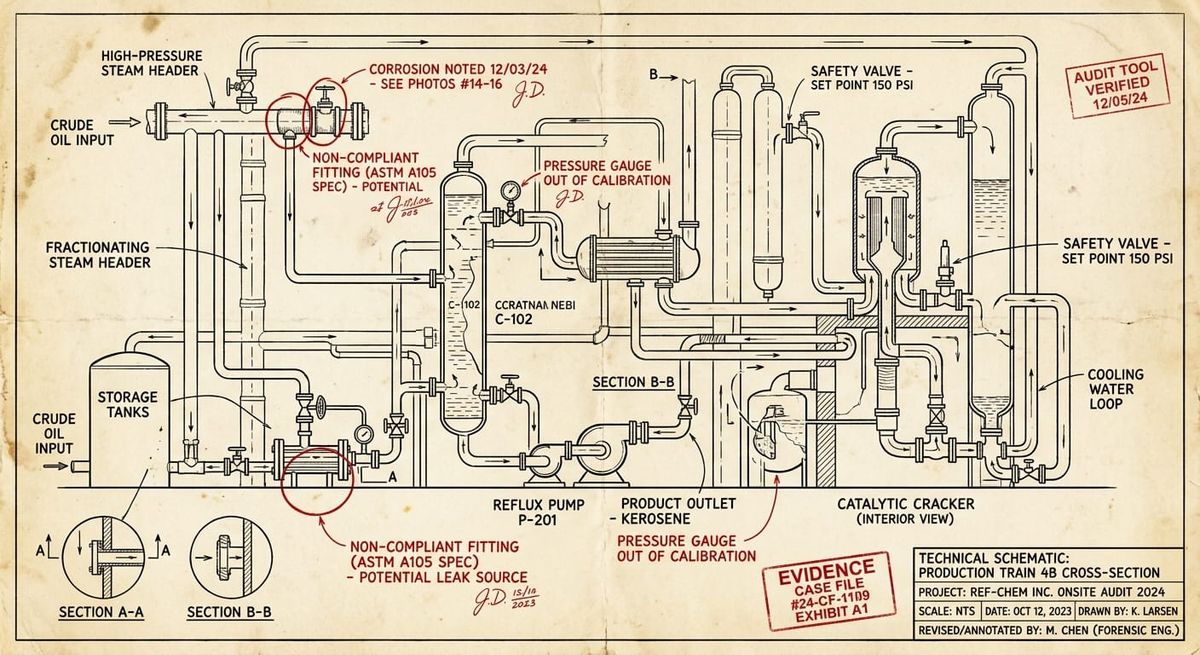
BASF's Ludwigshafen site — the company's largest and the most integrated chemical complex in the world — has been steadily losing its economic logic since European energy prices spiked after Russia's invasion of Ukraine in 2022. The company is running a savings program targeting roughly an additional €1.1 billion in cuts through 2026, and the plant's own director has said that decisions on which production units to close will only follow a thorough, unit-by-unit analysis. At the same time, BASF is committing roughly €8.7 billion to a new production complex in Zhanjiang, China — already running, not yet profitable, with management targeting 2027 as the point where it starts paying for itself.
Every part of that is defensible. It is also, right now, indistinguishable from a company that has simply chosen not to decide yet. We won't know which for another year or two. That's not a flaw in this autopsy — it's the honest version of what "wait and see" actually looks like from the inside, before anyone knows if it worked.
The Forensic Analysis
Here's where "gather more information" and "wait for certainty" stop being the same instruction. Three questions separate them:
1. Is this actually knowable right now, by anyone?* Energy prices and Chinese industrial demand aren't things a thorough analysis resolves — they're structurally uncertain, the same way next month's weather is. No amount of waiting converts that into a fact.
2. If something is knowable, what specifically do we need, and how do we get it?* "More clarity on the market" isn't an answer to this question. "Confirmed order volume from our top three customers by Q3" is.
3. If the honest answer is "we still choose to wait," what does that decision cost, stated as a number?* BASF has effectively already answered this one — the €1.1 billion cost-cutting target is, among other things, a price tag on how long sub-scale European capacity can keep running while Zhanjiang ramps toward 2027.
Former professional poker player Annie Duke, in *Thinking in Bets*, makes a distinction worth borrowing here: every one of these questions is a bet, not a verdict. The plant director isn't wrong to run the analysis — she's making a probabilistic call and describing it as certainty-seeking, which is a labeling problem, not a process problem. The autopsy here isn't "BASF should have decided already." It's "name the bet you're actually making, instead of calling it research."
The Observer Effect
The physics term for it: the act of measuring a system changes the system.
First-order: waiting avoids the risk of closing a plant that turns out to be worth keeping.
Second-order: suppliers, customers, and employees can't tell which decision is coming, so they start hedging against the worst case — pulling forward contracts elsewhere, treating the site as a lower priority for scarce investment.
Third-order: the hedging itself starts eroding exactly the utilization and order volume that a "thorough analysis" was waiting to observe. The wait doesn't just delay the decision. It can quietly manufacture the bad outcome it was trying to rule out.
Run Your Own Autopsy
BASF's numbers aren't your numbers. What the case gives you is the pattern — not your decision, your missing number, or your cost of waiting.
We built a five-question version of this autopsy for exactly that. [Run it on the decision you're currently sitting on →]
Open Questions
- What specifically are you waiting to find out — and if you can't name it precisely, what does that tell you?
- What would it cost, in real numbers, to keep waiting another quarter?
- If every founder facing this exact decision made the same call you're about to make, what would the industry look like in five years?
- Are you gathering evidence, or gathering cover?
- If the outcome goes badly, will you have made a bad decision — or an unlucky one? Would you be able to tell the difference in the moment you made it?
Destruction Desk
We perform autopsies on innovation’s failed assumptions.
This newsletter was edited by Manfred Lueth.
You received this email because you signed up for this newsletter from DestructionDesk.com.
To stop receiving this newsletter, unsubscribe or manage your email preferences