
What Northvolt Built Before It Could Run
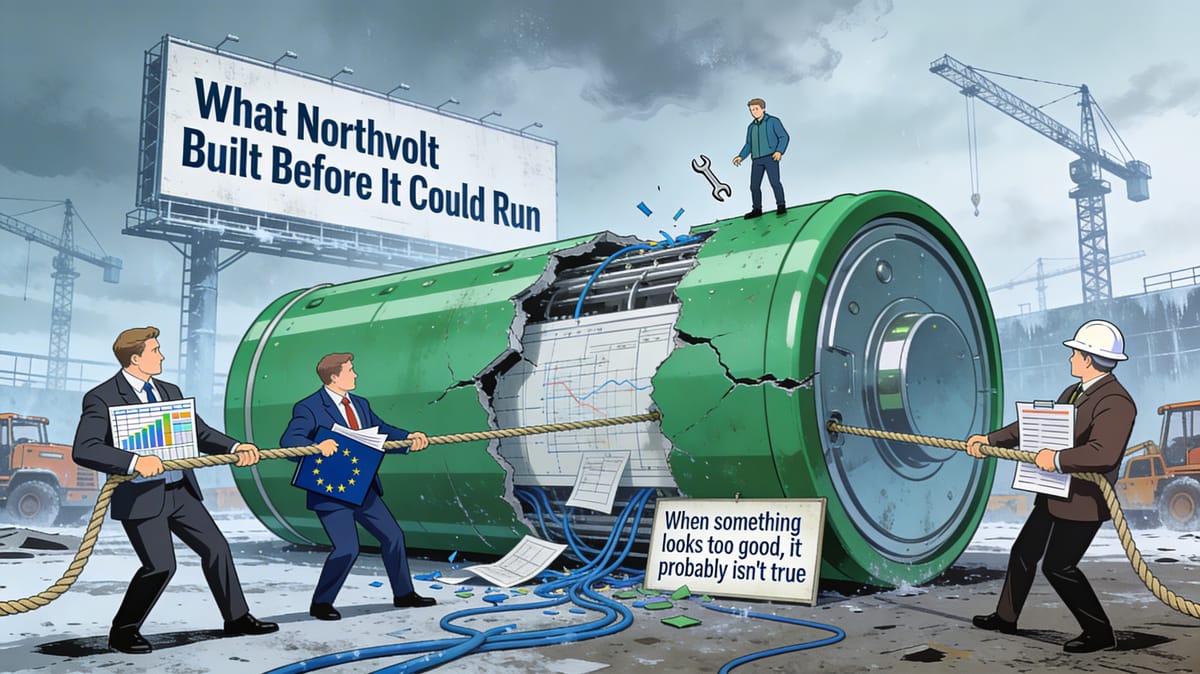
The Northvolt autopsy shows how founders lose execution authority when capital, governments, and customers all demand different definitions of success at the same time.
The Claim Under the Knife
Europe can build a homegrown battery champion that competes with Tesla and Chinese incumbents by combining patient capital, political backing, and sustainability-first manufacturing.
Northvolt became the embodiment of that claim.
Founded by former Tesla executives, backed by governments, OEMs, and institutional investors, Northvolt raised more than $13 billion to build Europe’s battery backbone. Its flagship factory in Skellefteå was framed not just as a plant, but as industrial policy made real.
A month ago, the dream came to an end and the company filed for Chapter 11 bankruptcy protection.
What assumptions failed before the collapse — when the outcome was still uncertain?
The Assumption We’re Dissecting
If you fund hardware scale aggressively enough, manufacturing excellence will follow.
Corollaries that went largely unquestioned:
- Talent from proven winners can be transplanted into new industrial contexts
- Capital can compress learning curves in complex manufacturing
- Political urgency can substitute for production maturity
- Sustainability-first design can coexist with first-of-a-kind scale
Northvolt was not reckless. It was conventional — according to how Europe believes industrial champions are built.
That’s precisely why the failure matters.
What Was Known by 2023–2024 (No Hindsight Required)
Long before bankruptcy, several structural signals were visible:
1. Persistent Production Delays
Northvolt’s core challenge was not chemistry, but yield and ramp-up. Public disclosures and partner signals indicated:
- Low initial yields
- Delayed customer qualification
- Slower-than-planned ramp toward automotive-grade volumes
In battery manufacturing, this is not a footnote. Yield defines survival.
2. The BMW Contract Loss
In mid-2024, Northvolt lost a €2 billion supply contract with BMW.
Officially, this was framed as a reprioritization. Structurally, it signaled something more damaging:
- OEMs were unwilling to wait for maturity
- Qualification timelines had slipped beyond acceptable risk
- Confidence in near-term execution had eroded
For a capital-intensive supplier, this was a credibility rupture — not just lost revenue.
3. Parallel Scaling of Too Many Unknowns
By 2024, Northvolt was simultaneously attempting to:
- Scale first-of-kind cell manufacturing
- Industrialize recycled battery inputs
- Build multiple gigafactories across geographies
- Serve tier-one automotive customers with zero tolerance for defects
Each of these is hard alone. Together, they multiply risk non-linearly.
The Core Failure Was Not Technology
This is where the myth persists.
Northvolt did not collapse because Europe “can’t do batteries” or because engineers failed. The deeper issue was manufacturing epistemology: how learning actually accumulates in hardware systems.
Battery factories do not scale like software platforms or even like automotive plants. They scale like chemical refineries with micron-level tolerances, where:
- Tacit knowledge dominates documentation
- Yield learning is slow, fragile, and local
- Automation amplifies errors before it corrects them
Capital accelerates construction.
It does not accelerate embodied learning.
Why the Model Looked Plausible at the Time
This is crucial. Northvolt wasn’t obviously doomed in 2019–2021.
The model made sense because:
- Tesla had vertically integrated batteries successfully
- China demonstrated state-backed scale at speed
- Europe faced strategic dependence risks
- ESG-aligned capital was abundant and patient
- Policymakers equated “gigafactory count” with capacity
What was underestimated was manufacturing memory — decades of iterative, loss-heavy learning embedded in Asian incumbents.
You cannot import that with headcount.
The Political Economy Trap
Northvolt sat at the intersection of three incompatible time horizons:
- Venture and growth capital wanted scale narratives
- Governments wanted sovereignty and jobs
- OEMs wanted qualified cells, on time, at spec
Each pushed in a different direction:
- Faster expansion
- More public signaling
- Less tolerance for delay
The company responded rationally — by expanding ambition rather than narrowing scope.
That decision was structurally incentivized.
Why This Wasn’t Just a Northvolt Problem
The deeper autopsy is not about one company.
Northvolt exposed a European pattern:
- Treating manufacturing scale as a financing problem
- Confusing factory construction with production mastery
- Assuming sustainability leadership reduces execution risk
- Believing “strategic” sectors suspend physics and learning curves
None of these assumptions hold in batteries.
The Forensic Conclusion
Seeing from today, the outcome was not yet inevitable — but the failure modes were already visible.
Northvolt did not run out of money.
It ran out of manufacturing slack.
The system asked it to:
- Prove sovereignty
- Demonstrate ESG leadership
- Match Asian incumbents
- Serve German OEMs
- Scale faster than its own learning curve
No amount of capital can satisfy all five simultaneously.
Why the Myth Will Persist
Because the alternative is uncomfortable.
Admitting this failure means accepting that:
- Some industrial capabilities cannot be fast-tracked
- Some dependencies take decades to unwind
- Some sectors reward patience more than ambition
- Some problems are not solvable with “European champions”
It is easier to call this bad execution than to question the model.
What This Autopsy Is Not Saying
- That Europe should abandon battery manufacturing
- That public–private partnerships are futile
- That sustainability and scale are incompatible
It is saying this:
You cannot skip the phase where factories lose money learning how not to fail.
And you cannot do that learning while being treated as a geopolitical symbol.
Cause of Death (Preliminary)
Not bankruptcy.
Not technology.
Not leadership.
Premature scaling under incompatible expectations.
Destruction Desk
We perform autopsies on innovation’s failed assumptions.
This newsletter was edited by Manfred Lueth.
You received this email because you signed up for this newsletter from DestructionDesk.com.
To stop receiving this newsletter, unsubscribe or manage your email preferences
Was this email forwarded to you? Sign up now to get DestructionDesk in your inbox.